
If you only learn one tarot layout, make it the three card tarot spread. It is quick, it fits on a small table, and it gives you enough information to say something useful without drowning you in symbols. A 3 card tarot reading is also the layout most people see first, whether they pull cards from a physical deck or ask an app to do it for them.
This guide covers the whole process. You will see why three cards work so well, how to shuffle, draw and lay out the cards, twelve named layouts with the questions that suit each one, a full worked reading narrated card by card, and how to handle reversals, repeated suits and repeated numbers. There is a short section on journaling and an FAQ at the end. Nothing here claims that cards predict anything. Tarot is a tool for reflection and entertainment, and the best readings are the ones that help you think more clearly about a question you already carry.
Why three cards work
One card is a snapshot. It can be striking, but it often leaves you with a mood and no direction. Ten cards, as in the Celtic Cross, give you a map, but a beginner can spend an hour trying to decide how card seven relates to card four and come away more confused than when they started.
Three cards sit in a sweet spot. Three is the smallest number that creates a sequence or a relationship with a middle. You get a beginning, a middle and an end, or two sides and what connects them, or a problem, a response and a result. Your brain is good at reading three things as a story, so you do not need a lookup table to make sense of it.
Finally, three card spreads are flexible. The cards stay the same, but the meaning of each position changes with the question. That means you can learn one skill and use it for love, work, decisions and plain curiosity. This is why the three card tarot spread is usually the first suggestion in any list of tarot spreads for beginners.
How to shuffle, draw and lay out the cards
There is no single correct ritual. What matters is that you have a clear question and a repeatable routine, so the reading feels deliberate rather than random. Here is a simple version.
Step 1: Write the question first
Before you touch the deck, write your question on a page. Open questions work better than yes or no ones. “What should I understand about my current job situation?” gives the cards room to respond. “Will I get promoted?” invites a verdict the cards cannot honestly give. If you are unsure, try starting with “what” or “how.”
Step 2: Choose the layout and name the positions
Decide on your three positions before you draw, and write them down left to right. Skipping this step is the most common reason beginner readings feel vague. If you pull cards first and invent positions afterward, you will bend the meaning to fit.
Step 3: Shuffle
Shuffle however feels comfortable. Overhand shuffling, riffle shuffling or simply swirling the cards face down on the table all work. Shuffle for as long as it takes to settle your attention, often under a minute. If you are using a digital reader, the shuffle happens for you, and you can ask the free AI tarot reader to lay a three-card spread with positions you choose.
Step 4: Draw and lay out
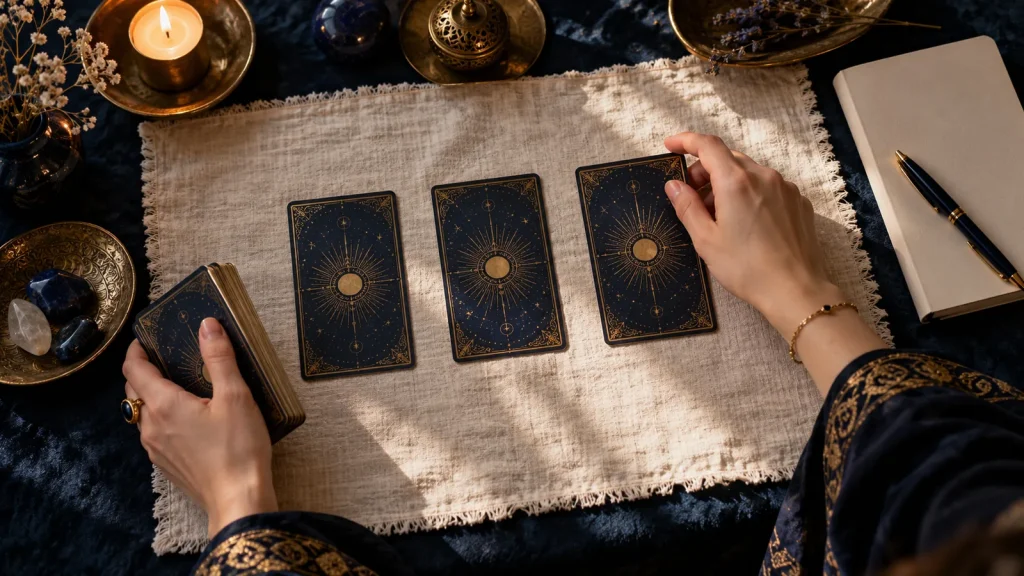
Cut the deck once if you like, then deal three cards from the top, face down, into a row from left to right. Turn them over one at a time, in order. Resist the urge to flip all three and react to the whole picture at once. Reading them in sequence keeps the story honest.
Step 5: Look before you interpret
Spend a few seconds with each card before reaching for a meaning. What is happening in the image? Who is in it, and what are they doing? How do you feel looking at it? Then bring in the traditional meaning. The tarot card meanings library is useful for the second part, as a reference to check your first impressions against rather than a script to read aloud.
Step 6: Read the row as a sentence
Finally, read the cards together. Ask how the first card leads to the second, and how the second leads to the third. A good three-card reading sounds like a short paragraph, not a list of three separate definitions.
12 three-card layouts and how to read them
Each layout below gives you the three positions, a question that suits it, and a note on how the cards talk to each other. Pick the one that fits what you are actually wondering about. You do not need to memorize them. Start with two or three and add more as they become familiar.
1. Past, present, future
This is the classic past present future tarot layout. Position one is what has shaped the situation, position two is where you are now, and position three is where things are heading if the current pattern continues. A good question is “How did I get here and where does this lean?” The key phrase is “if nothing changes.” The third card is a direction, not a fixed destination. Read card two as the hinge: does it continue the energy of card one, or does it interrupt it?
2. Situation, action, outcome
Here the cards are more practical. The first describes the situation, the second suggests an action or attitude, and the third shows a likely result of taking that approach. Ask “What is going on, what could I do about it, and what might follow?” The middle card matters most. If it feels impossible or uncomfortable, that is worth noticing. Sometimes the useful reading is realizing you do not want to do what the card suggests.
3. Mind, body, spirit
This one is a check-in rather than a forecast. Card one is your thinking, card two is your physical energy and daily habits, and card three is your sense of meaning or emotional depth. Ask “How am I doing right now?” Look for imbalance. Three busy, restless cards suggest you are overloaded. A calm card in one position next to a heavy one in another often points to where attention is needed. It is not a substitute for medical advice, only a prompt for self-reflection.
4. You, them, the relationship
Useful for friendships, family, colleagues and partners. The left card is you, the right card is the other person, and the middle card is the connection between you. Ask “What is the dynamic here?” Remember that the card for them is your reading of their energy, not a window into their mind. The middle card often matters most, especially when the two outer cards look very different.
5. Option A, option B, advice
A decision spread. Lay the first card for one choice and the second for the other, with the third as general advice. Ask “What should I weigh when choosing between these?” A hard-looking card for an option may be flagging a challenge you can prepare for, not a reason to rule it out. Let the advice card speak to the way you decide rather than to the decision itself.
6. Love tarot spread: self, partner, connection
A gentle love tarot spread for people who want to reflect on a romantic situation without asking whether someone loves them. Card one is what you bring, card two is what the other person brings, and card three is what the relationship needs. If you are single, swap the second card for “what I am looking for.” Cards like The Lovers often show up here, but remember that it points to choice and alignment of values as much as romance. The most useful question is “What do I want this connection to feel like?”
7. Challenge, strength, advice
Good when you feel stuck. The first card names the obstacle, the second names a resource you already have, and the third suggests a way to use it. Ask “What is in my way and what can I draw on?” Pay attention to whether the strength card feels believable. If you doubt it, ask yourself why. That doubt is often the real subject of the reading.
8. What to keep, what to release, what to welcome
A reflective layout that works well at the start of a month or after a big change. The first card is something worth holding on to, the second is something you could let go, and the third is something you are making room for. Ask “What do I want to carry forward?” Notice if the release card is a surprise.
9. Conscious, subconscious, integration
This layout explores the gap between what you say you want and what you may be avoiding. Card one is what you are aware of, card two is what sits beneath the surface, and card three is how the two could meet. Be careful with the middle position. It is a hypothesis to consider, not a diagnosis. If the card does not resonate, leave it. Not every card has to feel true.
10. Morning, afternoon, evening
A light daily spread. Draw it in the morning and treat the three cards as a rough shape for the day: how you start, how the middle goes, and how you wind down. Ask “What tone should I expect today?” and review it at night.
11. Where I am, what I need, where to look
For moments of drift. The first card describes your current state, the second names what you need more of, and the third points to where you might find it, such as a person, an activity or a mindset. Ask “What is missing right now?” Because the third card points outward, it is often the one people journal about longest.
12. Question, obstacle, hope
A simple emotional layout for anxious moments. Card one restates the heart of the question, card two shows the fear or block, and card three reveals the hope underneath. Ask “What am I really worried about, and what do I want instead?” Often the hope card reframes the whole row. If the obstacle card is something like The Tower, a hopeful card such as The Star in the third spot gives the row a kind of arc, from disruption toward recovery.
A fully worked example
Here is a complete reading, narrated step by step, so you can see how the pieces fit. This is an illustration of the method, not a real client session.
Suppose someone is wondering about a friend group that has drifted apart since two of its members moved abroad. They choose the past, present, future layout and write their question: “What should I understand about how this friendship circle is changing?” They write the positions down: past on the left, present in the middle, future on the right. They shuffle, cut, and deal three cards face down. Then they turn them over one at a time.
Card one, past: Three of Cups
The first card is the Three of Cups. Looking before interpreting, three figures raise their cups together, and the mood is celebratory. Traditionally this card stands for friendship, shared joy and community. In the past position, that matches the situation well. The group had a time of easy closeness, with regular gatherings and shared celebrations. The card is not saying that the past was perfect, only that this is the energy that shaped the group.
Card two, present: The Tower reversed
The second card is The Tower, and it lands upside down. Upright, The Tower is sudden upheaval, the collapse of something that was not as stable as it looked. Reversed, readers often take it a few ways: a disruption that is being resisted, a slow-motion unraveling instead of a sudden crash, or a change someone is avoiding. Here the third reading seems most natural. The group has not exploded. It is fading quietly, and nobody wants to name it. The reversal suggests the change is real, but that people are holding it at arm’s length.
Notice how the two cards interact. The Three of Cups shows the joy the group had, and The Tower reversed shows the shaking of that arrangement. Together they say something specific: the foundation that supported all those gatherings was geography and routine, and that foundation has shifted.
Card three, future: Page of Pentacles
The third card is the Page of Pentacles. A young figure studies a single coin with careful attention. This card traditionally speaks of learning, patience, small practical steps and a fresh start built slowly. In the future position it reads as an invitation to build something new on purpose. It does not promise the old group will return. It suggests that if the friendships are worth keeping, they will need steady, modest effort: a scheduled call, a shared project, a small ritual that works across distance.
Putting the sentence together
Now read the row as a short paragraph. “The group was built on easy, shared joy. That arrangement is now shaking, and I may be resisting admitting it. What comes next is not a big reunion but a patient, practical effort to build a different kind of connection.” That is an interpretation, not a prediction. The person reading it can decide whether it feels accurate and what, if anything, to do about it.
Reading reversals
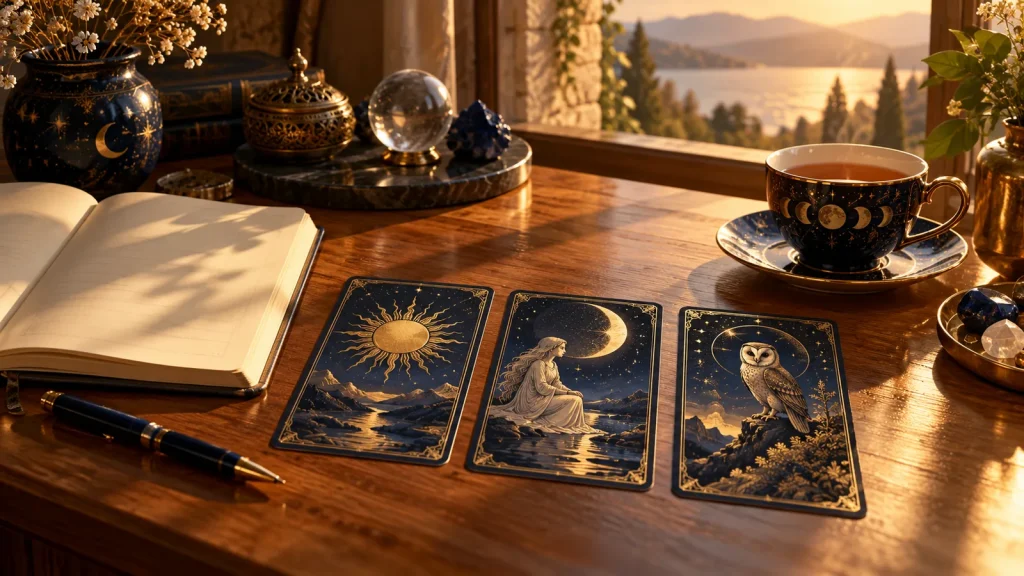
Reversed cards, the ones that land upside down, divide readers. Some skip them entirely and read every card upright. That is a perfectly good choice, especially for a beginner. If you do not want to deal with reversals, shuffle in a way that keeps all the cards facing the same direction, and you can ignore the issue.
If you want to include them, there are a few common approaches. None is official, and you can pick whichever feels natural.
- Blocked or internal energy. The card’s theme is present but held back, delayed or turned inward.
- Weaker or softer version. A reversed card can be the same message at lower volume.
- The opposite meaning. Some readers flip the meaning outright. This is the least subtle option and works best when the opposite is obvious.
- Something to look at more closely. A reversal can simply flag a card that deserves extra attention.
Whichever method you choose, stay consistent so your journal entries are comparable over time. And ask the same question you would for an upright card: what is happening in the image, and how does it relate to the position it sits in?
Repeated suits and repeated numbers
In a three-card row, patterns stand out quickly, and they can add a layer to your reading without adding complexity. Treat them as hints, not rules.
Repeated suits
- Two or three Cups: emotions, relationships and inner life are the main theme.
- Two or three Pentacles: money, work, health, home and practical matters.
- Two or three Swords: thinking, communication, conflict or mental strain.
- Two or three Wands: energy, ambition, creativity and motivation.
Repeated numbers
If you draw two threes, two fives or two tens, read the number as a theme. Threes are about growth and collaboration, fives about conflict or change, and tens about completion or overload. A pair of matching numbers across different suits invites you to ask how the same theme shows up in different areas of your life. For more on how numbers and suits feed into meaning, the tarot card meanings guide goes through the logic behind each card.
Journaling your readings
A reading that you forget is a lost chance to learn something. Journaling does not need to be elaborate. A few lines will do. The goal is to look back later and see how your interpretation held up.
A simple entry might include:
- The date and your written question.
- The layout and what each position meant.
- The three cards, including whether any were reversed.
- Your first reaction to each card, before checking a book or reference.
- Your one-paragraph summary of the whole row.
- A note to review in a week or a month.
When you review, ask what happened and whether your reading helped you notice anything. You will probably find that the cards were less useful as predictions and more useful as prompts. That is the honest way to use them. Over time, journaling also shows you which layouts you enjoy and which of your habits, such as always reading the third card as a promise, deserve a second look.
If you use a digital reader, you can save the output and add your own comments next to it. The AI tarot reading guide explains how to ask better questions and how to treat an automated reading as a starting point for your own thinking. You can also run a quick three-card spread with the free AI tarot reader and compare it with what you pulled from a physical deck.
Where to go next
Once this feels easy, browse the full tarot card meanings library one card at a time, and lay a three-card spread with the free AI tarot reader to practice.
FAQ
What is a three card tarot spread?
It is a layout where you draw three cards and assign each one a position, such as past, present and future. The positions give each card a role in the story, and you read the row left to right as a connected sequence. Because the positions are flexible, the same basic format can handle questions about love, work, decisions or self-reflection.
Is a 3 card tarot reading accurate?
Tarot does not predict the future, so accuracy is the wrong measure. A reading is useful when it helps you notice something, ask a better question or see a situation from another angle. Treat it as entertainment and a prompt for reflection, and keep decisions grounded in real information.
What is the best three card spread for beginners?
Past, present and future is the usual starting point because the positions are intuitive. Situation, action and outcome is also a good choice if you want something more practical. Both are among the easiest tarot spreads for beginners to learn and give you good practice in reading cards as a sequence.
Can I use a three card spread for love questions?
Yes. A simple love tarot spread uses three cards for you, the other person and the connection between you. Frame the question around understanding and communication, not around whether someone feels a particular way, since the cards cannot read another person’s mind. If you are single, you can use the layout to reflect on what you want from a relationship.
Do I have to read reversed cards?
No. Many readers use upright cards only, and that is fine. If you do include reversals, pick one consistent approach, such as reading them as blocked or internalized energy, and note it in your journal so your readings stay comparable.
How often should I do a three card reading?
There is no rule, but less often tends to work better than more. A reading once a week, or when you face a real question, leaves time to reflect. Pulling cards many times a day can turn into anxious checking, which defeats the purpose.
Leave a Reply