A few years ago, getting a tarot reading meant finding a deck, a quiet corner, or a person with a spare half hour. Now you can type a question into a browser and get a spread back in seconds. That convenience has made AI tarot reading one of the more popular ways to try tarot for the first time, and it has also made people curious about what is actually happening behind the screen.
This guide explains it plainly. You will learn how an AI tarot reader produces a reading, where it is genuinely useful, where it falls short, how it compares with sitting across from a human reader, and how to write tarot questions that lead to something worth thinking about. If you would rather skip straight to trying it, our free AI tarot reader is ready whenever you are. If you want the background first, keep reading.
One framing note before we start. Tarot is a tool for reflection and entertainment. It does not predict the future, and no honest reader, human or software, can promise otherwise. Everything below assumes you are using it to think, not to be told what will happen.
What an AI tarot reader actually does
The phrase “AI tarot” makes it sound like a machine has some mystical access to the cards. It does not. A typical AI tarot reader is a fairly ordinary combination of three parts, and understanding them removes a lot of the confusion.
Step one: the draw is random
When you ask for a reading, the software shuffles a digital deck of 78 cards and picks as many as your chosen spread needs. This is done by a random number generator, the same basic idea as shuffling a physical deck. Each card is also assigned an upright or reversed orientation, usually by another random choice.
Nothing about your question changes which cards appear. The language model does not choose the cards to fit your mood, and it does not know your future. The randomness is the part that mirrors a real shuffle, and it is the part that gives tarot its odd, prompt-like quality: you get a set of images you did not choose and have to make sense of them.
Step two: the cards carry stored meanings
Each of the 78 cards has traditional associations attached to it. The Tower stands for sudden upheaval and the collapse of something unstable. The Lovers is about choices and alignment of values, not only romance. The Hermit points toward solitude and inner guidance. These meanings come from centuries of tarot practice and vary a little between schools and decks.
A well-built AI reader holds a reference set of these meanings, upright and reversed, and attaches the right one to each drawn card. You can read the same kind of material yourself in the tarot card meanings library, including detailed pages such as The Tower and The Lovers. If you have never studied the deck, our guide to tarot card meanings is a good place to start.
Step three: a language model writes the interpretation
This is the part that is actually “AI.” A large language model receives your question, the cards that were drawn, their positions in the spread, whether each is reversed, and the stored meanings. It then writes a connected interpretation in plain language, tying the cards to what you asked.
A language model is good at this kind of synthesis. It can notice that a card about endings sits in the “present” position of your spread and that a card about new beginnings follows it, then describe that as a story. What it cannot do is know anything about your life beyond the words you typed. It has no access to your circumstances, your history, or the future. It is arranging symbols and language in a way that fits the question.
How accurate is an AI tarot reading?
This is the question most people really want answered, and it depends on what you mean by accurate.
If you mean “does it correctly predict what will happen,” then the honest answer is that no tarot reading can do that, human or AI. There is no evidence that shuffled cards carry information about future events. Anyone who tells you otherwise with certainty is selling something.
If you mean “is the reading faithful to traditional card meanings and internally coherent,” then a good AI reader can be quite reliable. It will describe The Tower as upheaval and not as a lucky windfall. It will treat a reversed card differently from an upright one. It will connect the cards to your question rather than reading each one in isolation.
If you mean “does it feel relevant,” that is where things get interesting, and where you should stay a little skeptical. Tarot imagery is deliberately open. Many people feel a reading “fits” because the language is broad enough to attach to almost any situation, a tendency psychologists call the Barnum effect. A language model is also trained to be agreeable and fluent, which can make a vague reading sound more insightful than it is. The feeling of accuracy is not the same as being accurate.
The useful way to judge a reading is not “did it get my life right” but “did it make me think about something I had not considered.” That is a modest standard, and a reasonable one.
AI tarot reader vs. a human reader
Neither is better in every situation. They offer different things, and it helps to be clear about which one you want.
| Factor | AI tarot reader | Human tarot reader |
|---|---|---|
| Availability | Any time, in seconds | Usually by appointment |
| Cost | Often free | Typically a fee per session |
| Privacy | No one watches you read it, though data handling varies by site | A real person hears your question |
| Consistency | Stays close to traditional meanings | Depends on the reader’s training and style |
| Responsiveness | Answers what you typed | Can read tone, follow up, adapt live |
| Emotional presence | None | Can offer warmth, pause and real attention |
| Accountability | A product with terms of use | A person with a reputation |
The practical split is this. An AI reader is a low-pressure way to practice, to journal, to get a quick prompt for a small decision, or to learn how spreads work. A human reader is better when you want conversation, when the topic is heavy, or when you simply want another person’s attention. Plenty of people use both: a quick AI draw on a Tuesday night, and a longer session with a person once in a while.
We have not tested every service out there and will not rank named competitors. Whichever you choose, look for clear language about entertainment use, plain pricing, and no promises about guaranteed outcomes.
Choosing a spread
The spread is the layout that gives each card a job. It decides how many cards you draw and what each position means. Three are worth knowing.
The one-card draw
One card, one question. It is the fastest option and works well as a daily check-in: “What should I pay attention to today?” The limitation is obvious. A single card cannot show relationships between ideas, so the reading rests on one symbol and one interpretation. Treat it as a prompt, not a full picture.
The three-card spread: past, present, future
The most popular layout. The first card represents what has shaped the situation, the second shows where you are now, and the third points to a direction the situation may be heading if things continue as they are. That last point matters. The “future” card is best read as a likely trajectory or a theme to watch, not a forecast.
Three cards are enough to see a small story form without overwhelming you, which is why this spread suits beginners and AI readers alike. Past, present and future is only one way to use three cards. You can also use situation, obstacle and advice, or you, the other person and the relationship. For a closer look at how to set these up, read our walkthrough of the three-card tarot spread.
The Celtic Cross
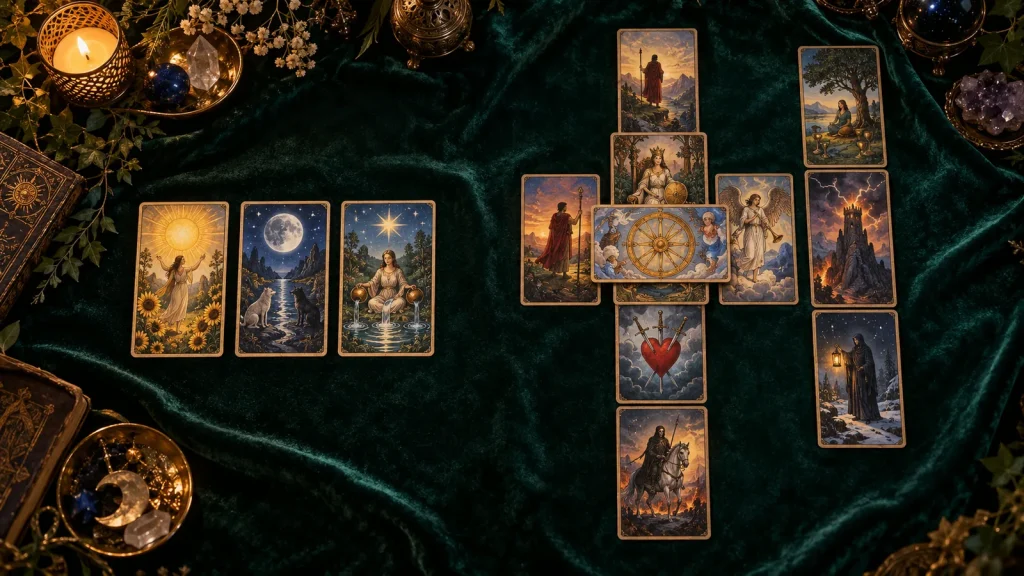
The Celtic Cross uses ten cards and is the classic spread for a complicated question. Its positions cover the heart of the matter, what crosses it, the foundation beneath it, recent past, possible outcome, near future, your own attitude, outside influences, hopes and fears, and a final result. It is rich and a little demanding.
With an AI reader, the Celtic Cross works best when your question has real depth. A ten-card reading in answer to “should I order pizza” is overkill, and the interpretation will feel padded. Save it for situations where you genuinely want to look at several angles at once.
How to ask better tarot questions
The quality of your question affects the quality of the reading more than any other factor. This is true with a human reader and doubly true with an AI, because the model has nothing to work with except your words.
Open questions beat yes/no questions
Tarot cards are not built to answer yes or no. They offer themes, tensions and perspectives. When you ask “Will I get the job?”, the cards cannot say yes or no, so the interpretation has to improvise an answer, and it often ends up vague or falsely confident.
Compare these pairs:
- Instead of “Will my ex come back?”, ask “What do I need to understand about how this relationship ended?”
- Instead of “Should I move to a new city?”, ask “What am I weighing most heavily as I think about moving, and what might I be overlooking?”
- Instead of “Will I be happy?”, ask “What is one area of my life that deserves more attention right now?”
Notice what changed. The better versions put you at the center, focus on understanding rather than prediction, and leave room for the cards to suggest something unexpected. They also avoid handing control of a decision to a shuffled deck.
Give some context, not your life story
A short line of background helps. “I am deciding whether to accept a role that pays more but has longer hours. What should I reflect on?” gives the reader something real to tie the cards to. A single word, or a paragraph of tangled detail, tends to produce a weaker reading than a clear sentence or two.
Ask about what you can influence
Questions about your own choices, reactions and next steps are more productive than questions about what another person is thinking or what an external event will do. You cannot learn someone’s private thoughts from a card, and the reading will only reflect your assumptions back at you. “How can I approach this conversation?” is far more useful than “What does he really think of me?”
One question at a time
Stuffing several questions into one reading splits the focus. If you have three concerns, run three readings. The cards will be easier to interpret and you will be less tempted to cherry-pick the pieces that sound nicest.
Reversed cards in an AI reading
A reversed card is one that appears upside down in the spread. Traditions differ on how to read them. Some readers ignore reversals entirely. Others treat a reversed card as the opposite of its upright meaning, a blocked or internalized version of it, or a milder form of it.
An AI reader usually has reversals as an option you can switch on or off. If you are new to tarot, starting with upright cards only is a perfectly reasonable choice. It keeps the readings simpler and lets you learn the base meanings first. Once those feel familiar, adding reversals gives each card a second layer.
For example, The Tower upright speaks of sudden change that shakes a foundation. Reversed, many readers take it to mean resisting a change that is already underway, or a smaller disruption that has been avoided. The Lovers upright is about choice and values. Reversed, it can point to misalignment or avoiding a decision. These are interpretations, not rules, and you will find different takes in different books. Our pages on The Tower and The Lovers lay out both orientations if you want to compare.

How to get something useful out of a reading
An AI reading is short-lived by default. It appears, you read it, and it disappears when you close the tab. A few habits make it more valuable.
- Write your question down first. It forces you to be specific and gives you something to compare against later.
- Read the cards before the interpretation. Look at the card names and your own first reactions, then read the AI’s take. Notice where you agree and where you do not.
- Challenge the reading. If a statement sounds oddly confident, ask what would make it untrue. This is the best defense against the Barnum effect.
- Pick one takeaway. A good reading does not need to change your whole life. One small thing to reflect on or try is plenty.
- Keep a short journal. Revisit entries after a few weeks. You will probably find that some readings seemed insightful at the time and some were simply wrong, and both are useful to see.
Treat the reading as a conversation starter with yourself. The cards do not need to be magical for the exercise to work. A prompt that makes you pause and think is already doing its job.
Privacy: what happens to your questions
People often type deeply personal things into a tarot box, and it is worth knowing where that text goes. We cannot speak for every site, but the general picture of how an AI reader works is useful.
Your question is typically sent to a server, passed to a language model along with the drawn cards, and returned as text. That means your words travel over the internet and may be processed by a third-party AI provider. Sites differ in whether they store readings, link them to an account, or use them for anything else.
Some sensible precautions:
- Skip identifying details. You do not need to include full names, addresses, workplaces or account numbers. “A colleague” works as well as a name.
- Never share passwords, financial details or health records. No tarot reading needs them.
- Read the privacy policy. Look for what is stored, for how long, and whether it is shared.
- Be careful with other people’s secrets. If a question involves someone else’s private information, generalize it.
A reading is a poor place to confess something you would not want anyone to see. If something is sensitive, keep it out of the text box.
When to see a human reader or a professional
This section matters more than any other in this guide. An AI tarot reader, and tarot in general, is a tool for reflection. It is not a source of professional advice, and there are situations where leaning on it can do harm.
Choose a human tarot reader when
- You want a real conversation about what the cards might mean to you.
- You would like follow-up questions, tone and presence, not just text.
- The topic feels emotionally significant and you would like another person to share it with.
Even then, a good human reader will frame the session as reflection, will not promise outcomes, and will not pressure you to spend more money or return repeatedly. Be wary of anyone who claims to see a curse, demands extra payment to “remove” a problem, or tells you to make major decisions based on a spread.
Choose a qualified professional when
- Mental health. If you are struggling with anxiety, depression, grief that will not ease, or thoughts of harming yourself, please talk to a licensed therapist, your doctor, or a crisis line in your country. A tarot reading is not therapy, and no spread should replace real support. If you are in immediate danger, contact local emergency services.
- Medical questions. Do not use cards to decide whether a symptom is serious or whether to start, stop or change a treatment. See a doctor.
- Legal matters. Contracts, custody, immigration, disputes and criminal issues call for a qualified lawyer, not a card draw.
- Money and investments. Do not base spending, borrowing, debt or investment decisions on a reading. A licensed financial adviser can look at your actual numbers.
A useful rule of thumb: if the consequences of a wrong decision would be serious or hard to reverse, tarot should not be the deciding voice. It can help you sort out how you feel about a decision. It should not make the decision.
Is AI tarot worth trying?
For most people, yes, with realistic expectations. A free AI tarot reader is a low-stakes way to learn the cards and see a situation from a new angle. Start small: pick a one-card or three-card spread, write an open question, and try our free AI tarot reader. If a card catches your eye, compare it with the card meanings library.
FAQ
Is AI tarot reading really free?
Many sites offer a free AI tarot reading, and ours does too. Free usually means a limited number of readings or a basic spread, with optional extras elsewhere. Check the terms of any site before you start so you know what is included and whether an account is required.
Can an AI tarot reader predict my future?
No. The cards are drawn at random, and a language model writes the interpretation using stored meanings and your question. Neither step gives access to future events. The “future” position in a spread is best read as a possible direction or theme to consider, not a prediction.
Is an AI tarot reading as good as one from a human?
It is different. An AI reader is fast, private and consistent with traditional meanings, which suits practice and quick reflection. A human reader can respond to your tone, ask follow-up questions and offer presence. Which is better depends on what you want from the reading.
What is the best kind of question to ask?
An open question about your own situation and choices, such as “What should I reflect on as I decide about this job offer?” Avoid yes/no questions and questions about what another person is thinking, since the cards offer themes, not verdicts or mind-reading.
Should I use reversed cards?
It is optional. If you are new, start with upright cards only to learn the core meanings. Add reversals later if you want extra nuance. Readers disagree on how to interpret them, so there is no single correct approach.
Is it safe to share personal details in a tarot question?
It is wise to keep it general. Your text is processed by software and possibly a third-party AI provider, and policies vary. Leave out names, contact details, passwords and financial or medical information, and read the site’s privacy policy to see how readings are handled.
Leave a Reply