Tarot looks intimidating from the outside. Seventy-eight cards, each with its own imagery, a pile of symbols, and a dozen books that disagree with each other. The good news is that the deck follows a clear structure, and once you see it, the individual tarot card meanings start to feel less like trivia and more like a connected story.
This guide walks through that structure from the top. You will see how the deck is divided, what every Major Arcana card stands for in a few words, how the four suits differ, how court cards work, and how to handle reversed cards without panic. It is written for people who are brand new to the cards and want a practical way to learn tarot without memorizing a phone book.
One honest note before we start. Tarot is a tool for reflection and storytelling. It does not predict your future with certainty, and no card can tell you what will definitely happen. What it can do is give you a prompt, a mirror, and a vocabulary for thinking about a situation from a new angle. Read the meanings below in that spirit, as starting points for your own thinking rather than verdicts.
If you want a full reference for every single card, the tarot card meanings library has a page for each of the 78. Think of this article as the map and the library as the street-level view.
How the 78-card deck is built
A standard tarot deck has 78 cards split into two groups. The Major Arcana holds 22 cards, numbered 0 to 21. The Minor Arcana holds the other 56, divided into four suits of 14 cards each. The word “arcana” simply means secrets, and “major” and “minor” describe weight, not importance. Major cards usually point to big themes, turning points and lessons. Minor cards describe the day-to-day texture of life: conversations, money worries, small wins, ordinary stress.
When a reading is full of Major Arcana, the situation often feels bigger than a single choice. When it is mostly Minor Arcana, the question tends to be practical and close to the ground. Neither is better. They answer different kinds of questions, and a good reading often mixes both.
The four suits and their elements
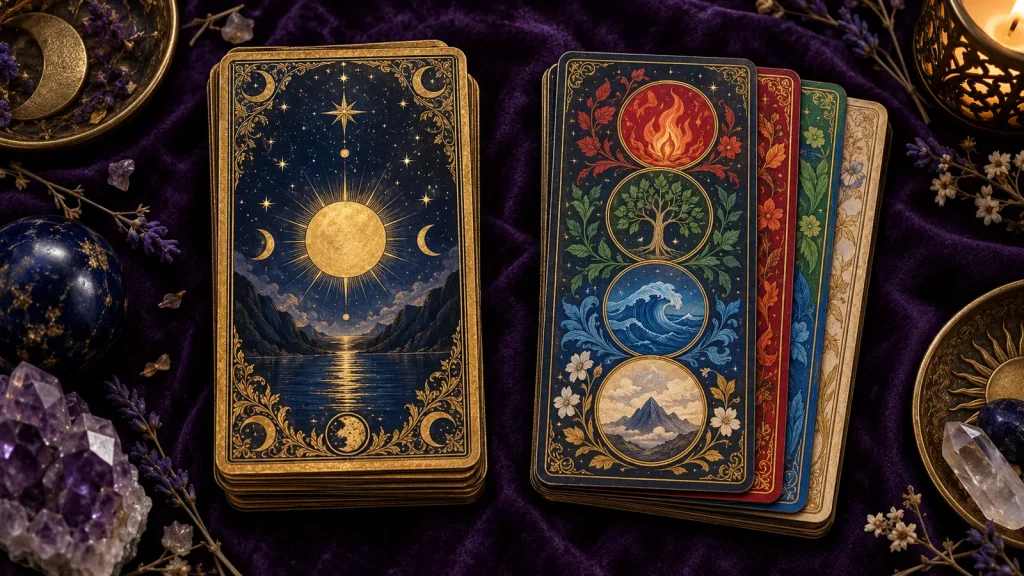
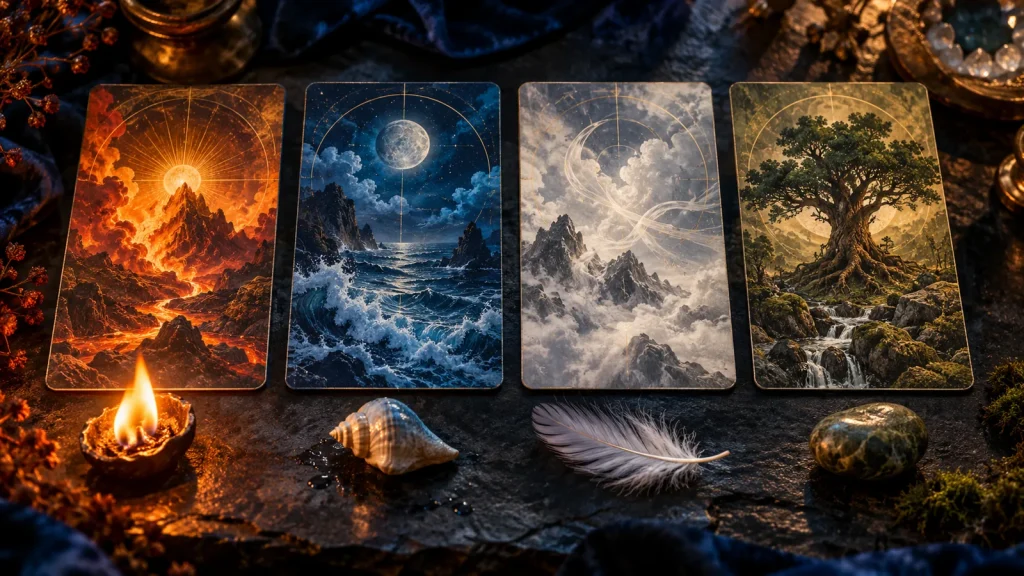
Each of the four tarot suits is tied to a classical element and an area of life. These associations are conventions, not laws of nature, but nearly every modern deck uses them, which makes them a reliable anchor.
- Wands: fire, energy, ambition, creativity, work drive.
- Cups: water, emotion, relationships, intuition.
- Swords: air, thought, communication, conflict, truth.
- Pentacles: earth, money, body, home, long-term building.
Some decks rename the suits. You may see Rods, Staves, Coins or Disks. The meanings stay the same, so a quick translation is all you need.
What each suit contains
Every suit runs from Ace to Ten, then adds four court cards: Page, Knight, Queen and King. That gives 10 number cards plus 4 court cards, so 14 per suit, and 56 across the four. The Ace is the seed of a suit’s theme, the Ten is that theme at its fullest or most strained, and the court cards describe people or attitudes connected to it.
The Major Arcana and the Fool’s journey
The 22 major arcana meanings are often read as a single story called the Fool’s journey. The Fool (card 0) starts out innocent and curious, then meets a series of teachers, temptations, crises and rewards before arriving at the World (card 21), a sense of completion. You do not have to treat this as a literal narrative, but it is a useful memory frame: early cards are about beginnings and learning the rules, middle cards are about testing and change, and late cards are about clarity and integration.
Roughly, the journey breaks into three stretches. Cards 1 to 7 cover building an identity in the outside world, from the Magician’s skill to the Chariot’s drive. Cards 8 to 14 turn inward and deal with strength, solitude, fairness, surrender and balance. Cards 15 to 21 cover the hard confrontation and the slow return to light, from the Devil and the Tower to the Sun and the World.
The table below gives a quick keyword summary for each card, upright and reversed. Click any card name for its full page in the card meanings library. Keywords are shorthand only. The same card can lean in different directions depending on the question and the cards around it.
All 22 Major Arcana at a glance
| Card | Upright keywords | Reversed keywords |
|---|---|---|
| 0. The Fool | New start, curiosity, leap of faith | Recklessness, hesitation, naivety |
| 1. The Magician | Skill, focus, resourcefulness | Manipulation, scattered effort, untapped talent |
| 2. The High Priestess | Intuition, mystery, inner knowing | Ignored instincts, secrets, confusion |
| 3. The Empress | Nurture, abundance, creativity | Smothering, creative block, neglecting self-care |
| 4. The Emperor | Structure, authority, stability | Rigidity, control issues, weak boundaries |
| 5. The Hierophant | Tradition, mentorship, shared values | Rebellion, outdated rules, personal belief |
| 6. The Lovers | Connection, alignment, meaningful choice | Disharmony, indecision, misaligned values |
| 7. The Chariot | Determination, momentum, willpower | Lack of direction, aggression, stalled progress |
| 8. Strength | Courage, patience, quiet confidence | Self-doubt, burnout, forcing things |
| 9. The Hermit | Solitude, reflection, guidance | Isolation, withdrawal, avoiding reflection |
| 10. Wheel of Fortune | Cycles, change, turning point | Resisting change, bad timing, feeling stuck |
| 11. Justice | Fairness, truth, accountability | Bias, dishonesty, avoiding consequences |
| 12. The Hanged Man | Pause, surrender, new perspective | Stalling, pointless sacrifice, resistance |
| 13. Death | Endings, transformation, release | Clinging, fear of change, slow decay |
| 14. Temperance | Balance, moderation, patience | Excess, imbalance, impatience |
| 15. The Devil | Attachment, temptation, unhealthy patterns | Breaking free, reclaiming power, awareness |
| 16. The Tower | Sudden upheaval, revelation, collapse | Avoided disaster, delayed change, fear of fallout |
| 17. The Star | Hope, healing, renewal | Discouragement, lost faith, drained energy |
| 18. The Moon | Uncertainty, dreams, subconscious fears | Clarity returning, confusion lifting, repressed feelings |
| 19. The Sun | Joy, vitality, clarity | Dimmed optimism, temporary gloom, overconfidence |
| 20. Judgement | Awakening, reckoning, calling | Self-criticism, ignoring the call, regret |
| 21. The World | Completion, wholeness, achievement | Loose ends, almost finished, lack of closure |
Notice that reversed keywords are not simply “the opposite.” Some reversed cards describe a blocked version of the upright energy, some describe an excess, and a few, like the Devil, can actually signal relief. More on that in the reversals section.
Minor Arcana: suit-by-suit overview
The minor arcana is where most of your readings will live, simply because there are 56 of them. Learning the four suits well gives you a decent grasp of more than two thirds of the deck, even before you memorize individual cards.
Wands: fire and drive
Wands cover ambition, creativity, projects, and the spark that gets you moving. The tone is energetic, restless and sometimes impatient. Positive Wands cards show enthusiasm and momentum. Troubled ones show burnout, scattered focus, or a fight for control. If a question is about work you care about, a side project, or finding motivation, expect Wands to appear often.
Cups: water and feeling
Cups are the suit of emotion, relationships, intuition and imagination. The tone is soft, reflective and sometimes moody. You will find love, friendship, nostalgia and joy here, but also disappointment, longing and emotional fatigue. The Ace of Cups is the classic opening: an offer of feeling, connection or kindness, waiting to be accepted.
Swords: air and mind
Swords deal with thought, speech, decisions and conflict. The tone is sharp, analytical and often uncomfortable. This suit has a reputation for being the hardest to look at, because it covers anxiety, arguments and painful honesty. Yet it is also the suit of clarity. The Ten of Swords looks dramatic, but its real message is that a painful chapter has hit bottom and there is nowhere further to fall.
Pentacles: earth and the material world
Pentacles cover money, work, health, home and anything you build slowly. The tone is steady, practical and patient. Good Pentacles cards show craftsmanship, security and reward for effort. Difficult ones show scarcity, perfectionism, or holding on too tightly to what you have.
A quick way to use this: when a spread feels confusing, count the suits. A pile of Cups suggests the question is really about feelings. Lots of Swords points to worry or a conversation that needs to happen. Several Pentacles bring it back to money, health or routine. A spread with plenty of Wands usually has something to do with motivation or a project that wants attention.
Number patterns from Ace to Ten
Here is a shortcut many beginners miss. The numbers on the cards carry their own meaning that repeats across all four suits. If you know what a “Five” tends to mean, you already have a head start on the Five of Wands, Cups, Swords and Pentacles.
- Aces: a seed, an opportunity, a fresh beginning in that suit’s area.
- Twos: choice, balance, partnership, weighing two options.
- Threes: growth, collaboration, first results.
- Fours: stability, pause, sometimes stagnation.
- Fives: conflict, loss, friction, a challenge to the stable Four.
- Sixes: recovery, giving and receiving, moving toward easier ground.
- Sevens: assessment, tested resolve, strategy and doubt.
- Eights: movement, skill-building, effort or restriction depending on the suit.
- Nines: near-completion, solitude, resilience, the final test.
- Tens: the end of a cycle, either fulfilment or overload.
Combine a number with a suit and you can often guess a card before reading its description. A Five of Cups is emotional loss (Five plus Cups). A Four of Pentacles is stability around money, sometimes with too much clinging (Four plus Pentacles). That guess will not always be perfect, but it gets you into the right neighborhood, and the library page for each card can refine the detail.
The numbers also tell a small story within each suit. The Ace plants the seed, the Twos and Threes grow it, the Fours steady it, the Fives test it, the Sixes and Sevens recover and reassess, the Eights and Nines push toward the finish, and the Ten closes the cycle. Seeing each suit as a ten-step arc makes the cards much easier to place.
Court cards: Pages, Knights, Queens and Kings
Court cards trip up almost every beginner, because they can mean three different things: a real person, an aspect of yourself, or a way of acting in a situation. There is no single right reading. Context decides.
A useful way to keep them straight is by role within each suit.
- Pages are students. They represent curiosity, news, early efforts and messages. Their energy is youthful and exploratory.
- Knights are action. They move toward a goal, and each one has a flaw: speed without thought, devotion that drifts, intensity that scares people, or plodding stubbornness.
- Queens are inward mastery. They embody the suit’s quality as a settled, emotionally intelligent presence.
- Kings are outward mastery. They represent leadership, responsibility and control over the suit’s domain.
Combine the rank with the suit and the personality appears. A Queen of Cups is warm, intuitive and emotionally generous. A King of Swords is analytical, fair and direct. A Knight of Wands is bold, charismatic and quick to get bored. A Page of Pentacles is a careful learner who treats a new skill seriously.
When a court card turns up, ask three questions. Does this describe someone in my life? Does it describe a side of me that I should lean into or soften? Or does it describe the style of action that would suit this situation? One of those usually fits better than the others. Avoid the common trap of assuming every court card is a specific person you know. Often it is simply a mood or approach.
How to read reversed tarot cards
Reversed tarot cards appear upside down after shuffling. Many readers use them, many ignore them completely, and both approaches are legitimate. If you are new, it is perfectly fine to read every card upright and add reversals later. Plenty of experienced readers do exactly that.
If you do want to include them, here are four common ways to interpret a reversed card. Pick one and stay consistent so you can judge how well it works for you.
- Blocked energy. The upright theme exists but is stuck, delayed or hard to access. A reversed Strength can suggest courage is there but you are not feeling it right now.
- Internalized energy. The theme is happening inside you rather than out in the world. A reversed Emperor might describe a struggle with your own inner discipline.
- Excess or deficiency. The upright quality is overdone or underdone. A reversed Temperance can mean either too much indulgence or too much restraint.
- The opposite. Sometimes the reversed card simply flips the meaning. It is the least subtle approach, but it works for cards like the Sun.
A few reversed cards are gentler than they look. A reversed Tower can mean you are avoiding a change you already sense is needed. A reversed Devil can describe loosening an unhealthy pattern. Do not assume reversed means bad. It usually means the energy is less straightforward.
Another trick is to look at the surrounding cards. If three upright, confident cards sit next to one reversed card, that one card is often the single area asking for attention. That context is more informative than the keyword list alone.
How to memorize the cards without cramming
You do not need to know all 78 cards by heart on day one. Nobody learns the deck that way, and the people who try often burn out. These habits work better for most people trying to learn tarot over a few weeks.
Draw one card a day
Pull a single card each morning, study the image for a minute, and write one sentence about what you notice. At the end of the day, add one line about whether the card connected to anything. After a month you will have met 30 cards in a personal context, which sticks far better than flashcards.
Learn the structure first
Spend your first week on the suit elements and number patterns described above. Once you know that Cups mean emotion and Fives mean friction, you can reason out most Minor Arcana cards. Then add the Major Arcana in groups of seven, following the Fool’s journey.
Read the pictures before the book
Look at a card and describe the scene in plain words: who is in it, what are they doing, what mood does it give you? Only afterward check the written meaning. Your first impression is usually close to the traditional one, and linking image to meaning is the real skill.
Practice with small spreads
Short spreads give you something to practice on without overload. A three-card tarot spread is the classic starting point, because it forces you to connect cards into a short story instead of reading each in isolation. If you want a guided example, the AI tarot reading guide shows how to frame a question and read the result.
Keep a simple journal
Record the date, your question, the cards, and your interpretation. Come back a few weeks later and reread. You will not be checking whether the cards “got it right,” since that is not what they do. You are tracking how your reading skill and your own thinking evolve over time.
Common beginner mistakes
Almost everyone makes the same handful of errors early on. Knowing them in advance saves a lot of frustration.
- Treating a card as a fixed fate. The Tower does not announce a disaster, and Death almost never means literal death. Cards describe themes and tendencies. What you do with them is up to you.
- Ignoring the question. A vague question gets a vague answer. “What should I know about my job situation this month?” works better than “Will I be happy?”
- Reading single cards in isolation. Meaning shifts with neighbors. A Three of Swords beside the Star reads differently from the same card beside the Moon.
- Memorizing keywords only. Lists help, but they flatten the cards. Always check the image and ask what it is actually showing.
- Drawing again until you like the answer. If you keep reshuffling for a better card, the reading stops being useful. Sit with the first result and ask why it bothers you.
- Using tarot for medical, legal or financial decisions. Tarot is a reflection tool. For decisions with real consequences, talk to qualified professionals.
- Expecting every reading to feel profound. Some days a card is just a card. That is normal, and a perfectly good result.
If you are not sure how a spread might look in practice, the free AI tarot reader lets you ask a question and see cards drawn with short interpretations. It is a convenient way to practice reading card combinations and to compare your own reading with a written one, though it is meant for entertainment and reflection, like any tarot reading. When you are ready for a closer look at a card that came up, head back to the card meanings library and read its page in full.
A simple four-week study plan
If you want a concrete path, here is an outline that fits around a normal schedule.
- Week one: learn the structure. Major versus Minor, the four suits, their elements and the number patterns. Draw one card daily and describe it without looking anything up.
- Week two: work through Major Arcana 0 to 10, using the table above and the matching pages in the library.
- Week three: finish Major Arcana 11 to 21 and begin on one suit, probably the one that matches your main interest.
- Week four: add court cards and try your first three-card spreads. Optionally start including reversals, using one method only.
After a month you will not know everything, but you will recognize most cards and be able to build a coherent reading around them. From there, depth comes from repetition, not from more reading. Try the same spread on a few different questions, compare how the cards shift, and let your own associations grow alongside the traditional ones. A personal vocabulary of images is what turns a list of tarot card meanings into an actual skill.
FAQ
How many cards are in a tarot deck?
A standard tarot deck has 78 cards: 22 Major Arcana and 56 Minor Arcana. The Minor Arcana split into four suits (Wands, Cups, Swords and Pentacles) of 14 cards each, made up of Ace through Ten plus Page, Knight, Queen and King.
Do I need to memorize every tarot card meaning?
No. Most readers rely on a mix of structure, imagery and intuition, with a reference book as backup. Learning the suits, elements and number patterns covers a large share of the deck, and the rest fills in through regular practice.
Are reversed tarot cards bad?
Not necessarily. A reversed card usually points to blocked, internal or exaggerated energy, not doom. Some reversals, like a reversed Devil, can describe relief or progress. Many readers skip reversals entirely, and that is a valid choice.
Which tarot card is the most negative?
Cards such as the Tower, Death, the Devil and the Ten of Swords look alarming, but they are better read as honest, sometimes hard, themes about change, attachment or endings. Each can carry a constructive message about release and renewal.
Can tarot cards predict the future?
No. Tarot cannot predict events with certainty. It works as a structured way to reflect on your situation, ask better questions and consider options. Treat any reading as a prompt for thought and enjoy it as entertainment, not as a forecast.
What is the best way to start learning tarot?
Begin with the deck structure, then pull one card a day and journal a short reaction. Use the tarot card meanings library to check individual cards, and practice small spreads once you feel comfortable with a handful of cards.
Leave a Reply